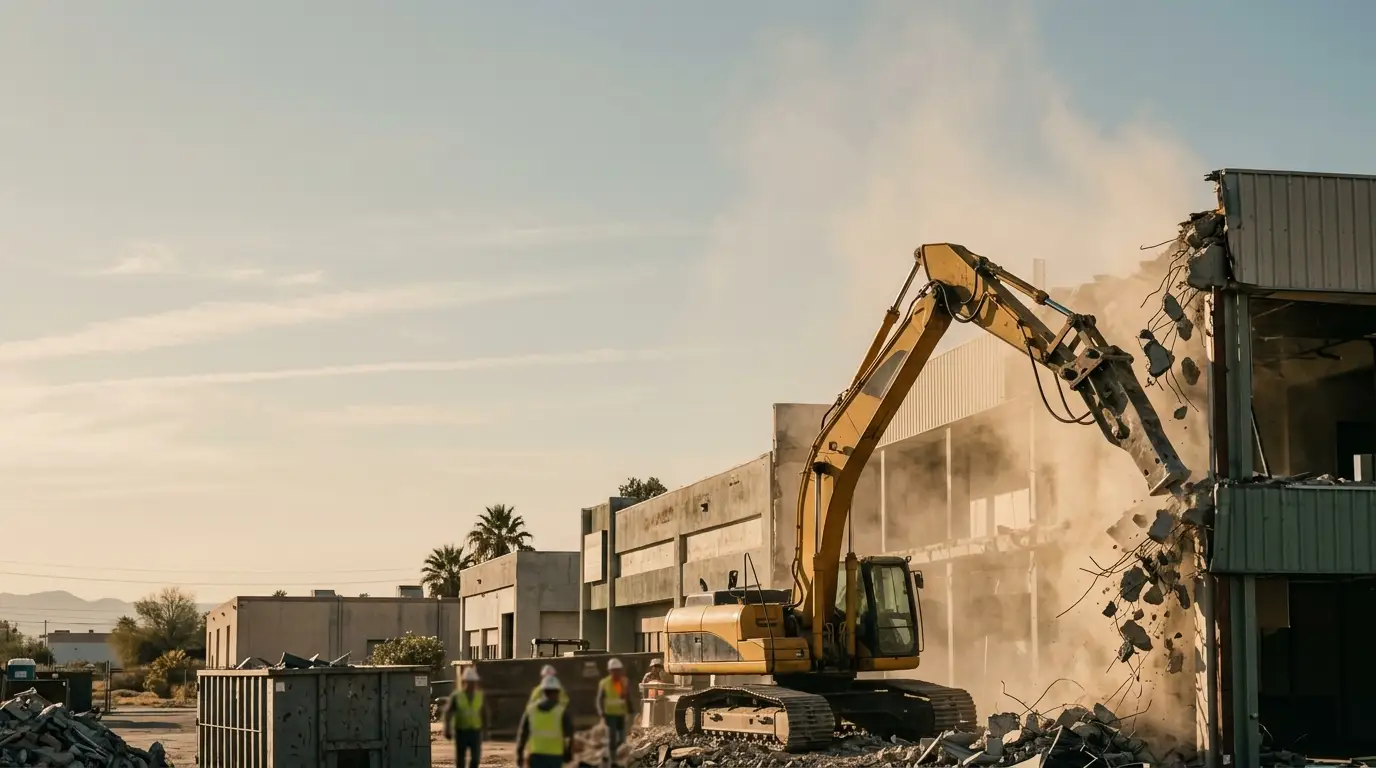
Commercial and structural demolition in Salinas covers a wider range of building types than residential work — retail storefronts along Main Street and North Salinas commercial corridors, warehouses and light-industrial buildings, and the packing houses and processing structures that are part of the Salinas Valley’s agricultural economy. Larger buildings, different construction methods, and often tighter site constraints mean commercial demolition is planned and sequenced differently than tearing down a house. This page covers what that process looks like and what it typically costs.
What Counts as Commercial & Structural Demolition
- Retail and office buildings — standalone or strip-mall structures being cleared for redevelopment or rebuild.
- Warehouse and light-industrial structures — often steel-frame or tilt-up concrete construction, which changes equipment and sequencing needs compared to wood-frame buildings.
- Agricultural and packing structures — coolers, packing sheds, processing buildings throughout the Salinas Valley, frequently older construction with materials — like cement-asbestos siding and roofing — that were standard decades ago.
- Partial structural demolition — removing a wing, a mezzanine, or a specific structural element while the rest of a facility stays in operation, which requires more engineering coordination than a full teardown.
The Survey Requirement Doesn’t Change for Commercial Buildings
What does change with commercial buildings is the scale of the survey itself: more square footage typically means more samples, more site time, and — because MBARD’s notification fee schedule scales with the quantity of regulated material involved — a larger notification fee than a residential project. Building that into your project timeline up front avoids a surprise when the survey comes back.
Engineering and Sequencing on Larger Structures
Unlike a detached residential structure, commercial and structural demolition often involves buildings with shared walls, adjacent occupied tenants, or non-standard construction (tilt-up concrete panels, structural steel, long-span roofing). For these projects:
- A structural engineer typically reviews the demolition sequence before permits are finalized, to ensure the building comes down in a controlled order that doesn’t compromise adjacent structures or utilities.
- Utility coordination is more involved — commercial buildings often have multiple service connections (power, gas, water, sometimes fire suppression systems) that all need proper disconnection and capping.
- Vibration and dust monitoring may be part of the plan on sites near occupied buildings, particularly along active commercial corridors.
- Phased removal is common on larger sites — clearing interior systems and non-structural elements before structural demolition begins, which is both safer and often more cost-effective for material recycling.
Who Performs Commercial Demolition Work
The same CSLB C-21 (Building Moving/Demolition) license classification that covers residential demolition governs commercial and structural work — it’s defined by license type, not building size. What typically differs on larger commercial projects is the scale of equipment (larger excavators, high-reach demolition attachments for multi-story structures) and the number of subcontractors coordinated on site: demolition, abatement (if the survey requires it, performed by a separate Cal/OSHA-registered contractor), debris hauling, and site grading are often separate scopes on a commercial job, coordinated by the general demolition contractor.
What Does Commercial Demolition Cost in Salinas?
Commercial and structural demolition costs vary more widely than residential, driven by:
- Building size and construction type — steel-frame and tilt-up concrete generally cost more per square foot to demolish than wood-frame construction.
- Site access — downtown Salinas storefronts with limited equipment access cost more than open ag-valley sites with room to maneuver.
- Material findings — asbestos abatement, if the survey identifies regulated material, is priced and scheduled separately before demolition proceeds.
- Recycling and disposal — concrete, steel, and wood recycling can offset some disposal cost; general debris and any asbestos waste are priced separately.
- Engineering and permitting — larger or shared-wall structures typically require engineering review, which adds to project cost and timeline.
Our cost guide covers typical local ranges by project type. Because commercial scope varies so much, an accurate number always follows a site visit rather than a phone estimate.
Serving Salinas’s Commercial Corridors and the Salinas Valley
We connect property owners and developers with C-21 licensed demolition contractors experienced in retail, warehouse, and agricultural structures across Salinas, Marina, Seaside, Castroville, Gonzales, Soledad, and Watsonville — coordinating the survey, MBARD notification, engineering review where needed, and the demolition itself as one managed project.