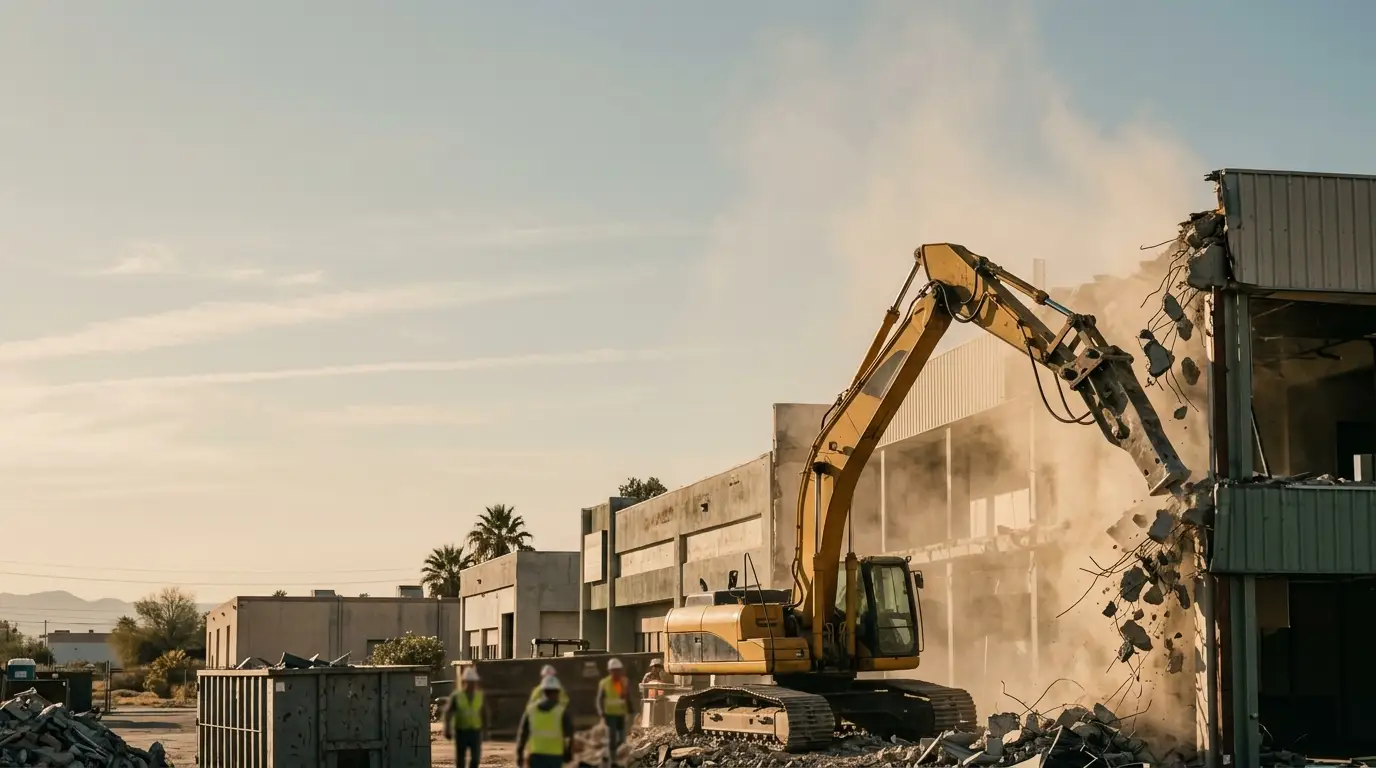
Salinas has a wide mix of housing stock — post-war bungalows near downtown, mid-century ranch homes, and newer construction throughout North Salinas and the Alisal — and residential demolition comes up for all of it: a fire-damaged structure, a teardown ahead of new construction, an old garage or outbuilding that’s outlived its use, or a full lot-clearing before a rebuild. This page covers what residential demolition actually involves in Salinas, what has to happen before the crew arrives, and what it typically costs.
What Counts as Residential Demolition
Residential demolition covers a range of scope, and the right approach depends on what’s coming down:
- Full structure teardown — the entire house, down to the foundation, typically ahead of a rebuild or a lot sale.
- Partial demolition — removing an addition, a garage, or a damaged wing while the rest of the structure stays.
- Outbuilding and accessory structure removal — sheds, detached garages, barns on larger residential lots, old agricultural structures on properties at the edge of the Salinas Valley.
- Interior strip-out — gutting a structure to the studs ahead of a major remodel, which is treated as a renovation for regulatory purposes but often uses the same crews and equipment as demolition.
Every one of these, if it involves a load-bearing structural member, falls under MBARD’s demolition notification requirement — and every one requires the pre-work asbestos survey regardless of how small the structure looks.
Before the Crew Shows Up
A well-run residential demolition follows a predictable sequence, and skipping steps is what turns a two-day job into a two-month delay:
- Asbestos survey. Non-negotiable, and the long-lead item — get it scheduled first.
- Demolition permit. Filed with the City of Salinas (or the county, for unincorporated parcels), typically requiring the survey results as part of the application.
- MBARD notification. At least 10 working days before demolition starts; the fee schedule and process are on our survey requirements page.
- Utility disconnection. PG&E has to cap or remove electrical and gas service, and water/sewer connections need to be capped at the property line — arrange this early, since utility scheduling can take longer than the demolition itself.
- Site protection. Fencing, erosion control, and dust control measures (particularly relevant for Salinas’s dry, windy stretches) go up before work begins.
Who’s Allowed to Do the Work
Residential demolition in California is performed under a CSLB C-21 (Building Moving/Demolition) contractor license — a distinct classification from general building contractors, requiring documented trade experience and a contractor bond before the state issues it. If the survey finds asbestos-containing material that needs to come out first, that abatement work requires a separately Cal/OSHA-registered contractor. On many residential jobs the same company holds both credentials and coordinates the sequence; on others, a specialist abatement contractor clears the material and hands the site to the demolition crew. Either way, ask for both license numbers before work starts — a legitimate contractor expects the question.
What Does Residential Demolition Cost in Salinas?
Residential demolition pricing is driven by a handful of factors that move the number more than anything else:
- Square footage and structure type — a detached garage costs a fraction of a full house teardown; multi-story structures cost more per square foot than single-story.
- Foundation type — slab-on-grade foundations require more breakout work than raised foundations.
- Asbestos findings — if the survey identifies material that needs abatement, that’s a separate cost added before demolition can proceed.
- Debris hauling and disposal — volume and distance to an authorized disposal facility both affect the bill.
- Site access — a tight urban lot with limited equipment access costs more than an open rural parcel.
- Post-demolition grading — whether the lot needs to be graded flat and seeded, or simply cleared, changes the final line item.
Our cost guide breaks these out with typical local per-square-foot ranges. Treat any quote given without a site visit as a placeholder — real numbers come after someone has actually looked at your structure.
Living Near an Active Demolition Site
If you’re staying in a home adjacent to a demolition project, or demolishing one structure while living in another on the same property, expect a few practical realities: dust control measures (water misting is standard on Salinas Valley sites, especially in dry summer months), noise during active teardown hours, and temporary fencing around the work zone for safety. A licensed contractor will walk you through the site plan, the expected timeline, and how debris hauling traffic will be managed before the first day of work.
Serving Salinas Homeowners and Monterey County
From downtown Salinas bungalows to properties throughout Marina, Seaside, Castroville, Gonzales, Soledad, and Watsonville, we connect homeowners with C-21 licensed demolition contractors and certified asbestos consultants who handle the survey, the notification, and the teardown as one coordinated project — not three separate headaches.